
Citrus Tree Care in Phoenix: Feeding, Pruning & Watering
Straight answers for Phoenix-area homeowners & property managers — from a licensed local landscaping contractor serving the Valley since 1999.
☎ (602) 439-5192 Request a Free Quote
- ROC #207713
- Licensed & Insured
- Family-owned since 1999
- 4.5★ · 865+ reviews
In the Phoenix low desert, healthy citrus comes down to four habits: feed three times a year — the easy-to-remember version is Valentine's Day, Memorial Day, and Labor Day — prune only in late winter or early spring to avoid sunburning exposed bark, water deep and infrequently on a schedule that shifts with the seasons, and protect young trees whenever a hard freeze is forecast between December and February. The holiday feeding schedule is the Arizona nursery-trade shorthand for University of Arizona Cooperative Extension's own split-nitrogen guidance, which breaks the year into three feeding windows that shift slightly by citrus type. Get those four habits right and a Phoenix citrus tree can produce reliably for decades; Victor's Landscaping builds all of it into residential maintenance plans across the Valley.
When should I fertilize citrus trees in Phoenix?
Use the schedule Arizona nurseries and long-time Valley growers rely on: feed citrus trees around Valentine's Day (mid-February), Memorial Day (late May), and Labor Day (early September) — three feedings a year, each carrying roughly a third of the tree's annual fertilizer.
That's the memorable version of University of Arizona Cooperative Extension's actual guidance, which splits the same total dose across the year a little differently depending on citrus type:
- Oranges, mandarins and grapefruit: one-third in January-February, one-third in March-April, one-third in May-June.
- Lemons and limes: one-third in January-February, one-third in March-April, one-third in August-September — and about 10% more total fertilizer per year than sweet citrus.
The three-holiday version simplifies both charts into one schedule that works for every citrus tree in the yard, which lines up closely enough with the extension's windows to perform well in practice and is far easier to remember than tracking two separate calendars. Use a high-nitrogen citrus fertilizer and spread it evenly under the canopy, starting about a foot out from the trunk and extending to just past the drip line — never piled against the trunk itself. Hold off on this full schedule the first year after planting — UA's own chart calls for little to no nitrogen on a newly planted tree until it's rooted in and pushing new growth. For how much to use, University of Arizona's fertilization chart scales the yearly total by tree size, from roughly 1/4 to 1/2 lb of actual nitrogen a year for a young 2-3 ft tree up to 1 1/4-1 1/2 lb for a mature tree over 10 ft tall; check your fertilizer's nitrogen percentage on the label to convert that into pounds of product.
The Three-Feeding Citrus Calendar
Feed on the holiday, not the date — three feedings a year covers most Phoenix citrus.
Lemons & limes: shift the third feeding to Aug–Sep per UA Extension.
When and how should I prune citrus trees in Phoenix without risking sunburned bark?
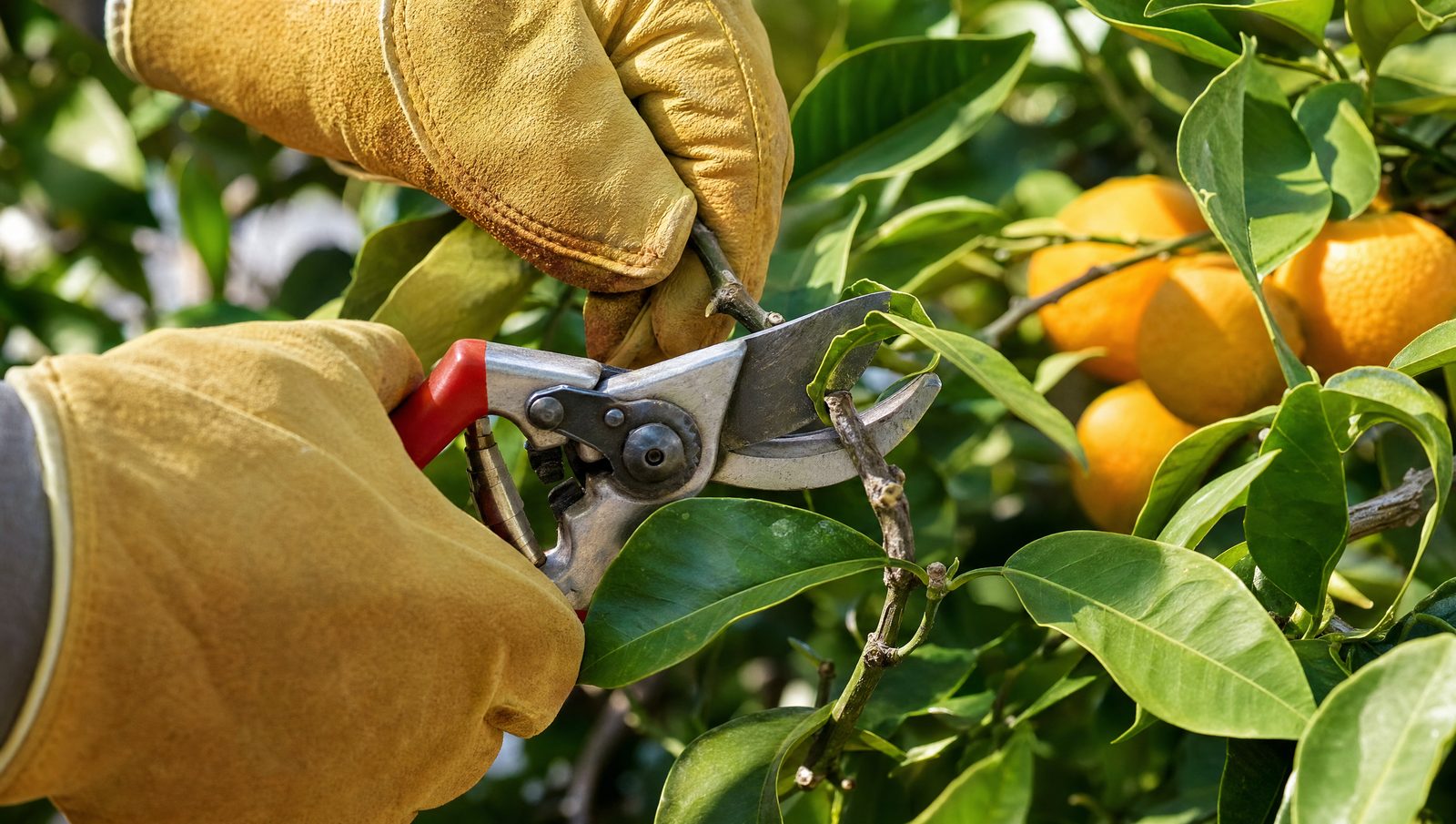
Save major structural pruning for late winter through early spring — generally late February through April in the Phoenix area, after the risk of a hard freeze has passed but before summer heat sets in. That timing gives new leaves time to fill back in and shade the bark before the most intense sun arrives.
Light cleanup — hand-pulling dead twigs and suckers — pairs well with the September feeding mentioned above. Save anything that needs a saw or loppers for the late-winter window; Extension guidance is to avoid cutting beyond small, hand-removed growth between May and mid-October, since it exposes bark that's been shaded all summer.
The mistake we see most often in Phoenix yards is over-pruning in summer. A citrus tree's canopy exists partly to shade its own bark, which isn't built to take direct desert sun. Opening up the tree's interior or exposing south- and west-facing limbs by cutting too much, too late in the season, leads to sunburned bark: a faded, yellowish patch that turns dry and brittle as the damage sets in, and can kill the bark outright in bad cases. If a limb has already lost its leaf cover, shield or wrap the exposed bark rather than cutting deeper into the canopy to compensate. When in doubt, prune less rather than more, and let the tree keep its natural rounded shape instead of shearing it flat or hollowing out the middle. Our residential tree service times structural citrus pruning to the late-winter window and handles the technique that keeps bark protected.
Need a hand?
Not sure when to feed yours? We'll take a look — free.
Feeding, pruning, and watering set up right, on one visit.
How often should I water citrus trees in Phoenix, and does that change by season?
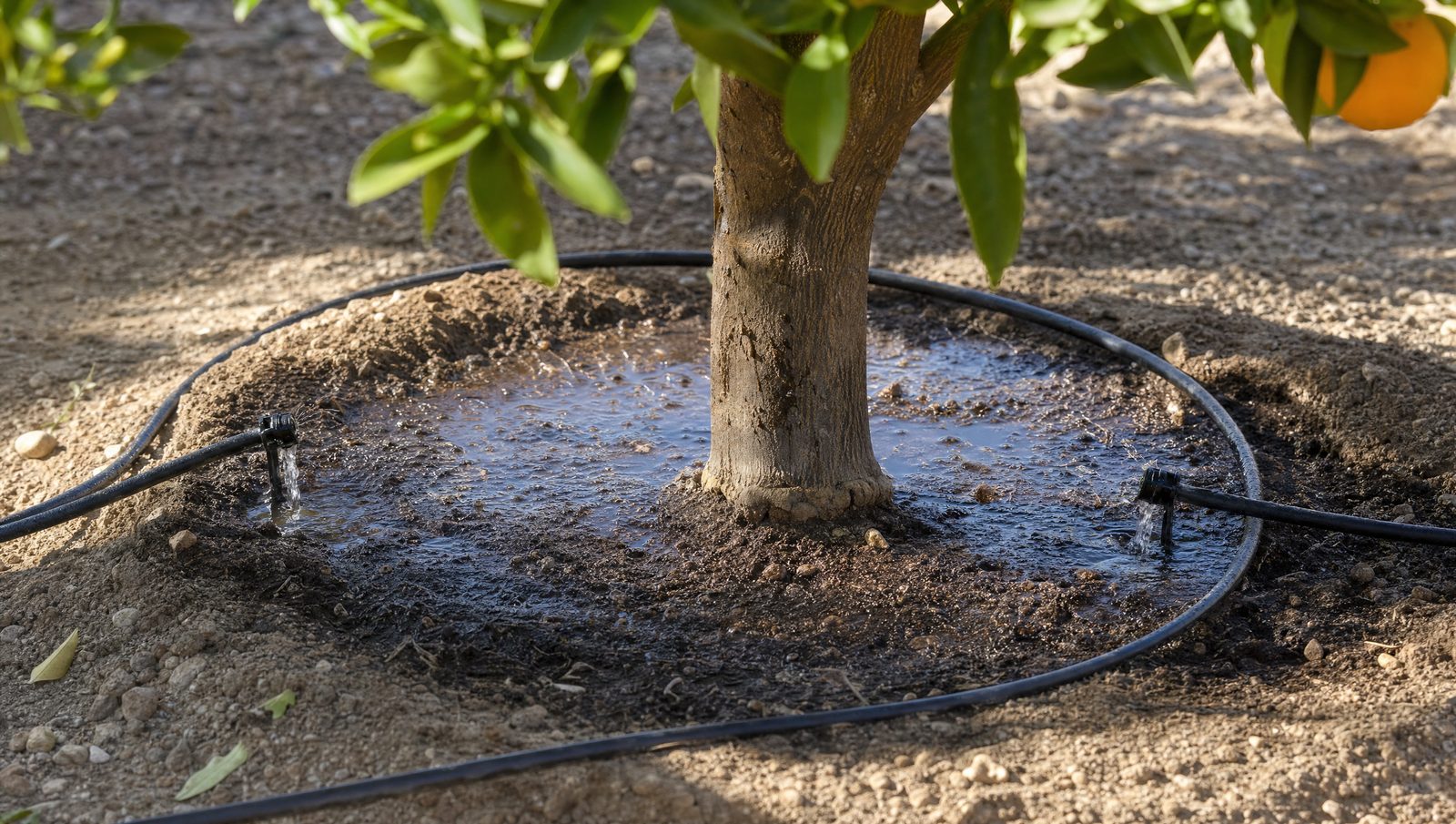
Citrus wants deep, infrequent watering, not frequent light sprinkles, and how often changes a lot across a Phoenix year. As a general guide for an established tree (roughly 3+ years old), University of Arizona Cooperative Extension recommends:
- Summer (July-September): every 10-14 days
- Late spring/early summer (May-June): every 14 days
- Spring and fall (March-April, October-November): every 14-21 days
- Winter (December-February): every 21-30 days
Each irrigation should wet the soil from the trunk out to just past the canopy's drip line, to a depth of at least two feet — a real deep soak, not a quick spray. Frequent, shallow watering does two things wrong: it keeps roots shallow and close to the surface, where they're more exposed to summer heat and winter cold, and it lets salts build up in the upper root zone instead of getting flushed down past it. Newly planted trees need more frequent watering through their first year or two while roots establish; mature trees can go longer between waterings using the schedule above. If you're not confident your system is dialed in for citrus, our irrigation and sprinkler service can adjust drip run times and emitter placement by season.
Summer · Jul–Sepevery 10–14 days
Late spring · May–Junevery 14 days
Spring · Mar–Aprevery 14–21 days
Fall · Oct–Novevery 14–21 days
Winter · Dec–Febevery 21–30 days
How do I protect young citrus trees from frost in a Phoenix winter?
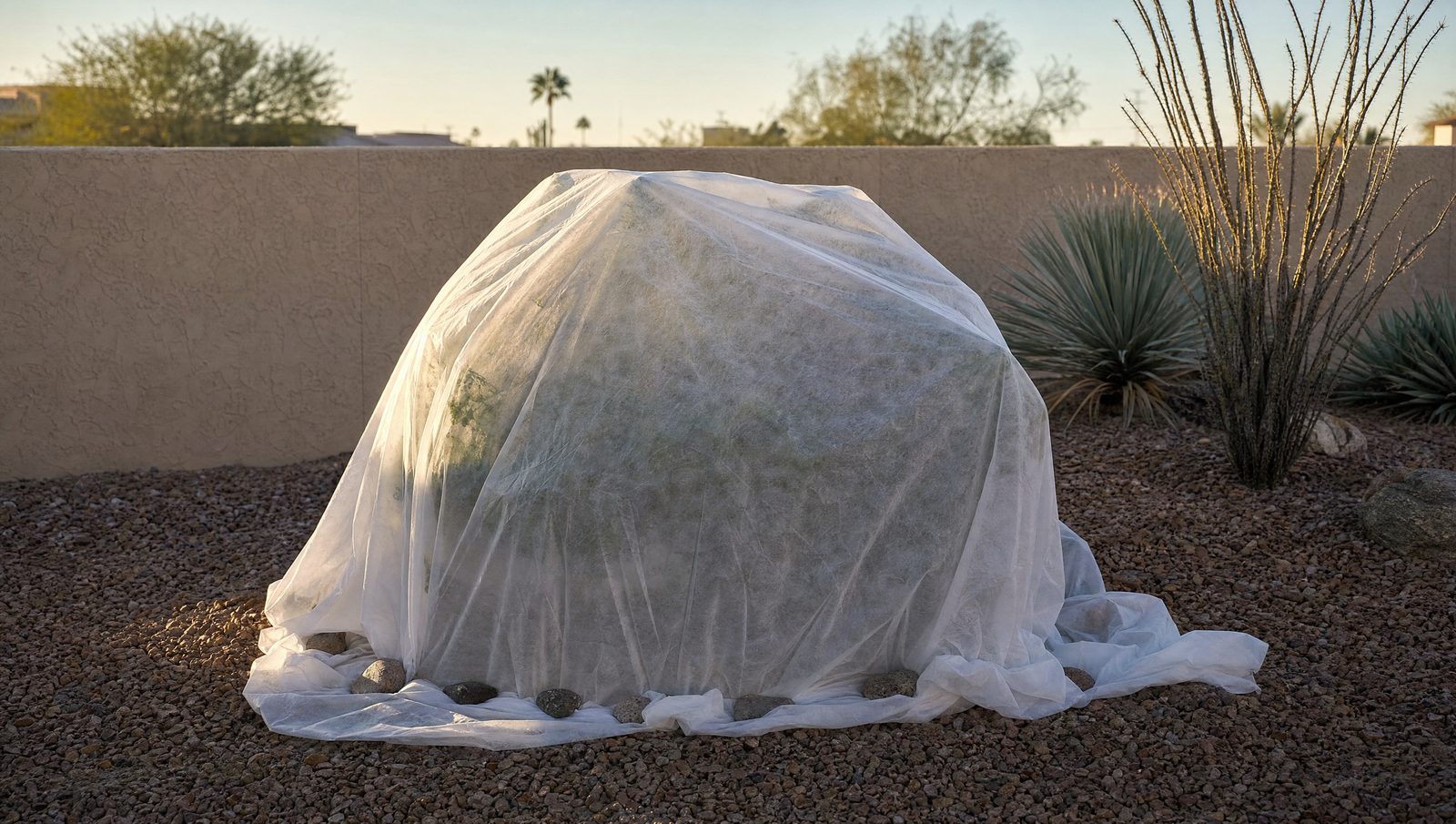
Give extra attention to young or newly planted citrus (generally under about three years old) whenever a hard freeze is forecast, roughly mid-November through mid-February in the Phoenix area — their thinner bark and shallower roots make them far more vulnerable than an established tree.
- Cover the whole canopy, all the way to the ground. Use cloth, burlap, or a frost blanket — never plastic — draped completely over the tree so it traps heat radiating up from the soil. Take covers off once daytime temperatures climb back into the 50s so the tree doesn't break dormancy underneath.
- Wrap the trunk and graft union. Multiple layers of weatherproof paper or cloth around the trunk, extending up to the lower branches, can stay in place for the whole cold season (roughly mid-November through mid-February). This matters most at the graft (bud) union near the base of the trunk: if the top of the tree freezes back past that point, whatever regrows will be the rootstock, not the fruiting variety you planted.
- Leave frost damage alone until spring. Wait until new growth appears before pruning out anything that looks dead. Cutting too early stimulates tender new growth that a second cold snap can damage all over again.
Mature, established citrus in the Valley usually shrugs off an ordinary winter night; it's young trees and tender new growth flushes that need the consistent cover.
Need a hand?
Not sure when to feed yours? We'll take a look — free.
Feeding, pruning, and watering set up right, on one visit.
Why are my citrus tree's leaves turning yellow between the veins?
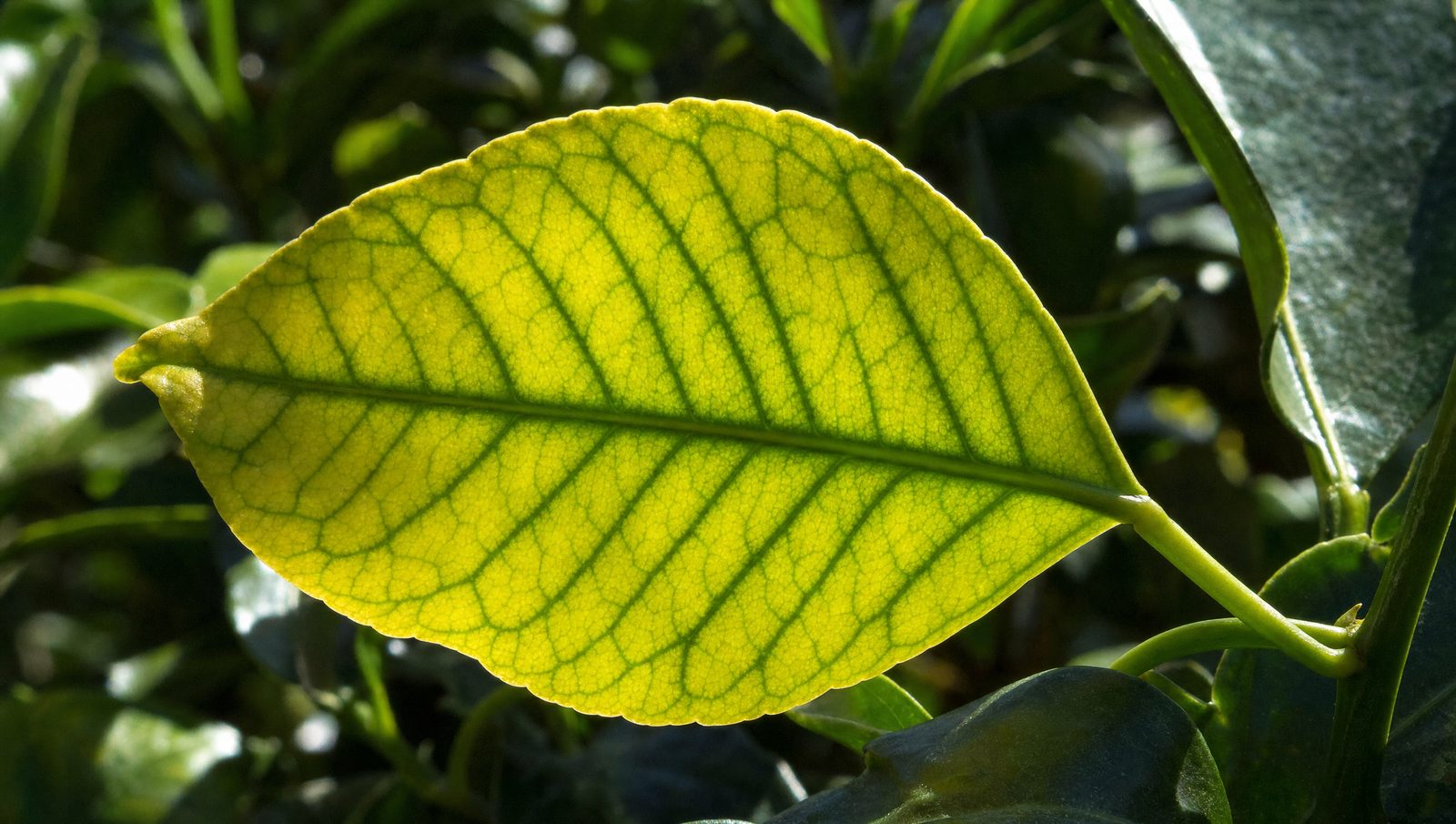
Yellow leaf tissue with the veins staying dark green — known as interveinal chlorosis — usually shows up first on new spring growth, and in the Valley it's almost always iron deficiency. The cause typically isn't a lack of iron in the soil; most Phoenix soils have plenty. The problem is our alkaline soil (commonly pH 7.5-8.5), which locks iron into a form roots can't absorb.
The fix is a chelated-iron product labeled for alkaline or desert soils, applied to the soil or as a foliar spray. University of Arizona Cooperative Extension notes similar interveinal yellowing can also point to a zinc deficiency, so if iron treatment alone doesn't clear it up, a combined chelated iron-and-zinc product is worth trying. Overwatering can compound the problem by suffocating roots and blocking nutrient uptake, so check your irrigation schedule at the same time you treat the soil.
Why does my citrus fruit split or drop before I can pick it?
Two different things are usually going on, and neither means the tree is unhealthy:
- Fruit split (the rind cracks open while still on the tree) is mainly caused by inconsistent watering and fertilization, or sunburn, per University of Arizona Cooperative Extension. A tree that swings from bone-dry to a heavy soak pushes the inner fruit to swell faster than the rind can stretch. Even, scheduled deep watering — not sporadic watering whenever someone remembers — is the main fix, along with keeping to a regular feeding schedule.
- Fruit drop in spring is often completely normal: citrus trees set far more fruit than they can actually support and shed the excess on their own. That said, the extension notes drop is heavier during hot, dry, windy weather and on trees that are underwatered or under-fertilized, so a tree dropping an unusual amount of fruit is worth checking against its watering and feeding schedule before writing it off as the tree just thinning its own load.
Keeping the three-times-a-year feeding schedule above and a consistent, season-adjusted watering routine addresses the root cause of both problems more reliably than any one-time fix.
What citrus varieties do best in the Phoenix low desert?
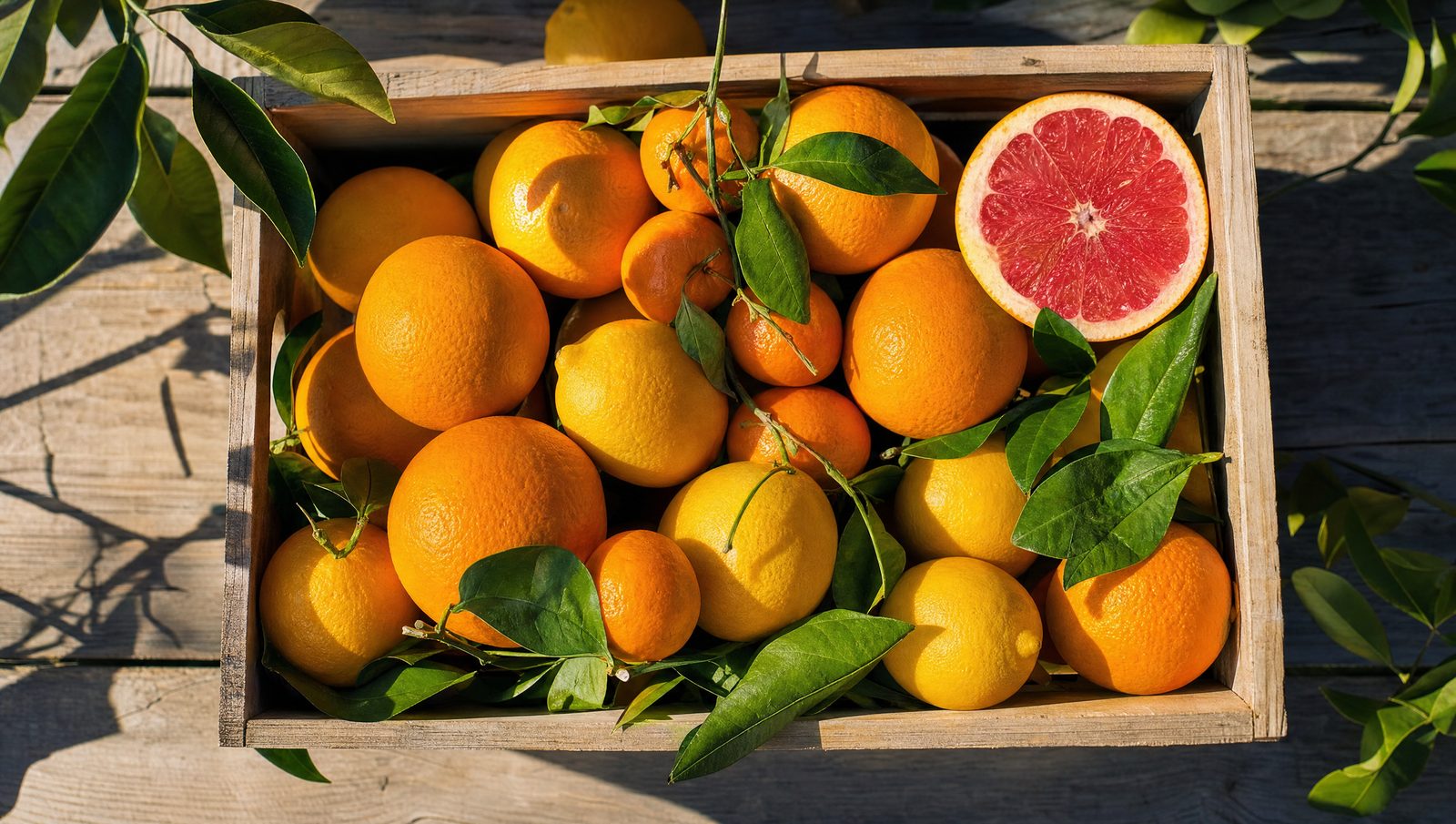
Not every citrus variety sold nationally handles Valley heat and our occasional hard freeze equally well. Varieties with a track record in the Phoenix low desert include:
- Oranges: Arizona Sweet (a Valencia-type bred for the desert), Valencia, Washington navel, and Marrs (an early-ripening navel-type).
- Mandarins: Kinnow and Daisy do well in the Valley; Owari satsuma is a more cold-hardy option worth considering if frost is a bigger concern on your property.
- Grapefruit: Rio Red and other red-fleshed varieties; grapefruit and pummelo need only about half the annual fertilizer of other citrus types.
- Lemons: Meyer lemon (thinner-skinned, more cold-tolerant, a heavy year-round producer) or Lisbon and Eureka lemon for a more classic tart lemon.
- Limes: Bearss (Persian) lime is the most reliable choice in our climate; Mexican (Key) lime is more frost-sensitive and better suited to a sheltered spot near the house.
Whatever you plant, give it full sun and well-drained soil, and plan on extra frost protection for its first couple of winters no matter the variety. As a family-owned, licensed Arizona contractor (ROC #207713) serving the Valley since 1999, with a 4.5-star average across 865+ reviews, Victor's Landscaping folds citrus feeding, pruning, and seasonal care into standing residential maintenance plans and one-off tree service visits — so the right schedule doesn't depend on you remembering three holidays yourself.
Get a Free Landscaping Quote
Tell us about your property and we’ll follow up fast — or call ☎ (602) 439-5192.